
Enough Is Enough: Carr Backs FCC Plan to Jam Prison Cell phones as Families Demand Justice
By Carol A. Gasser Moore |
ATLANTA — Georgia Attorney General Chris Carr is applauding a groundbreaking move by the Federal Communications Commission (FCC) to give prisons the power to jam contraband cell phones, calling the proposal “a long overdue step to save lives.”
The FCC will vote on September 30, 2025 to allow state and federal correctional facilities to block inmate cell phone signals, a practice that has been prohibited for decades under federal law. The plan marks the first time prisons could legally disable phones smuggled behind bars. 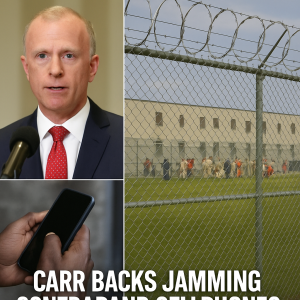
A Crisis of Violence Fueled by Contraband Phones
For years, Georgia has been at the epicenter of the contraband cell phone epidemic. Last year alone, the Georgia Department of Corrections (GDC) confiscated more than 15,500 phones and 150 drones used to smuggle them into facilities.
The human toll has been devastating:
- In Tattnall County, an incarcerated leader of the “Yves Saint Laurent Squad” gang used a cell phone to order the killing of an 88-year-old military veteran.
- In Atlanta, two 13-year-old boys were gunned down in a drive-by shooting, allegedly orchestrated by a gang leader behind prison walls.
“These are not isolated incidents,” Carr warned. “Prisoners with contraband cell phones are ordering murders, and this has to stop now.”
Years of Resistance, Now a Breakthrough
Carr has been pressing Washington for change since 2022, arguing that outdated FCC rules left states powerless to stop inmates from plotting crimes.
- In June 2024, he urged the FCC to reconsider its decades-old stance, pointing out that the U.S. Bureau of Prisons had already permitted federal penitentiaries, including one in Georgia, to use jamming devices.
- By December 2024, frustrated with inaction, he filed a FOIA request demanding documents on FCC communications and its response to his calls for reform.
- Earlier this year, Carr rallied a bipartisan coalition of 31 attorneys general to support legislation (H.R. 2350 and S. 1137) that would allow states to deploy jammers.
This latest FCC action, he said, “finally shows we have partners in the White House and the FCC who are willing to work with us to keep people safe.”
What Happens Next
The FCC vote later this month is expected to pass, though not without controversy. Wireless industry groups have expressed concerns that jamming could disrupt legitimate communications, including 911 emergency services.
To address this, FCC officials have pledged to conduct a public comment period and craft strict safeguards before implementation. Facilities will not be required to use jammers but will have the option.
“This is about striking a balance,” FCC Chair Brendan Carr explained. “We must stop gang leaders from directing murders from inside their cells, while also ensuring the public’s access to critical services like 911 is never compromised.”
The Emotional Stakes for Georgia Families
For victims’ families, the vote cannot come soon enough. Community leaders say the killings tied to prison-ordered hits have shaken public trust in the justice system.
“This isn’t about politics,” one Atlanta pastor said. “It’s about making sure no other grandmother, no other child, has to die because a convicted murderer has more access to a cellphone than to his conscience.”
Looking Ahead
If approved, the new rules could be rolled out as early as 2026, with Georgia expected to be among the first states to adopt the technology.
“This is a chance to shut down the pipeline of violence,” Carr said. “We cannot wait any longer.”
___________________________________________________________________
Explainer: How Prison Cell phone Jamming Works — and Why It’s Controversial
What is cell phone jamming?
Jamming technology works by sending out powerful radio signals that block or disrupt cellular networks in a targeted area. Inside prisons, this would mean that smuggled phones simply can’t connect to a tower, rendering them useless for calls, texts, or internet access.
Why has it been banned?
Under 47 U.S.C. § 333, federal law has long prohibited states from interfering with licensed radio communications, including cell phone signals. The concern was that jamming could spill outside prison walls and disrupt legitimate wireless service. Only federal facilities under tightly controlled circumstances have been allowed to test it.
Why is it being reconsidered now?
- Public safety: Inmates have been caught using contraband phones to order murders, coordinate gang violence, run fraud schemes, and traffic drugs.
- Technology improvements: Newer jamming tools can be more precise, targeting small areas without affecting nearby communities.
- Political pressure: Attorneys general, including Georgia’s Chris Carr, have argued that existing bans are outdated and leave prisons vulnerable.
What are the risks?
Wireless industry leaders warn that poorly managed jamming could interfere with 911 calls or emergency communications. That’s why the FCC says it will create strict safeguards and testing protocols before facilities are allowed to turn the devices on.
What happens next?
- FCC vote: Scheduled for September 30, 2025.
- Public comment period: Regulators will take input from law enforcement, wireless providers, and the public before finalizing rules.
- Implementation: States would then decide if and how to deploy jamming, likely starting in high-risk facilities.





Cell phones in prisons MUST BE JAMMED for the safety of law abiding people. The are used not only for gang activities but also for ordering items to be smuggled in and directing payments to those who do it. This must be done immediately. 2026 is 25 years too late. Make it immediate and make it required in all prisons.
Your comment is appreciated! Thank you for reading the Lanier County News!