A tale of the dead made Valdosta’s M.E. Thompson governor after historic ‘Three Governors Controversy’… Granddaughter says sharecropper youth at root of his progressive views
By T.S. Carter
GEORGIA – Melvin Ernest Thompson became Georgia governor in 1947 by giving life to a story of the dead.
It’s a tale that became cemented in Georgia political lore nearly 80 years ago in “The Three Governors Controversy.”
It unfolded this way:
Newly elected as Georgia’s first lieutenant governor, but not yet inaugurated, the former supervisor of state schools expected to serve part-time running the state Senate when in session and spending the rest of his time operating an appliance store he opened in Valdosta. Then on December 21, 1946, Governor-elect Eugene Talmadge died a couple weeks short of his inauguration.

Lieutenant Governor
Melvin E. Thompson
So, as lieutenant governor-elect, Thompson thought he was the new governor.
But so did the supposed write-in vote winner Herman Talmadge.
And so did incumbent Governor Ellis Arnall, who claimed the right to serve until someone could be legally sworn in.
Thus was “The Three Governor’s Controversy.”
Thompson suspected chicanery in the totals of Herman Talmadge general election’s write-in votes, especially over late-arriving ballots that could have risen from out of the ground for all Thompson knew.
Those ballots of suspect origins jumped Herman Talmadge from third place to first.
But Thompson had proof of the trickery, and played that card like a riverboat pro.
Go to Telfair County and check the origins of the “write-in” votes for Herman Talmadge, the lieutenant-governor-elect advised the Atlanta press.
His tip to the press came after Herman Talmadge emerged as the winner of a scheme by the Legislature to make the late governor’s son his replacement. Legislators did a tally of the write -in votes, but Talmadge came in third – until newly discovered votes from his home county of Telfair emerged and put him over the top.
But wait a minute on those write-ins! Thompson said after the Legislature ignored his claim to the governor’s office in favor of Herman Talmadge.
“Thompson knew what was going on” in Herman Talmadge’s home county of Telfair,” said Dr. Chris Meyers, professor of Georgia history at Valdosta State University.
Get over there and check it out, Thompson told the Capital press corps. It won’t be a dead end, he promised.

Thompson said, “It won’t be a dead end!”
And it wasn’t. They found instead that the votes of 56 of Telfair County’s dead were used to bury the younger Talmadge’s two opponents, Talmadge Bowers and James Carmichael.
“And they did it in alphabetical order!” exclaimed Professor Meyers.
In a class he teaches at VSU that includes the “Three Governors Controversy” of 1947-48, Meyers likes to give students the first words of an article by Atlanta Journal writer C.E. Gregory:
“Do you know that they rose from the dead in Telfair County, marched in alphabetical order to the polls, cast their votes for Herman Talmadge and went back to their last repose?”
With the votes of the dead and acceptance of their votes, the Legislature declared Herman Talmadge the new governor. He quickly moved into the governor’s office and changed the locks. “It was a Talmadge legislature,” Meyers said, explaining how Talmadge got away with it.
Herman was the insurance his father’s campaign badly needed, Myers noted.
With Eugene Talmadge suffering from liver disease, the campaign feared the senior Talmadge might not make it to inauguration day. Thus, it set up Herman as a write-in candidate — just in case, Meyers said.
But the Legislature awarding of the governorship to Herman Talmadge was not the end of the matter for either Thompson or Arnall. They set up offices in the foyer of the capitol building, button-holing power players as they came and went from the governor’s office Herman Talmadge.

Arnall and Thompson set up offices
in the capitol building foyer
Herman Talmadge’s claim to the office died with the Georgia Supreme Court declaring in March 1947 that Thompson was the rightful governor, because he was lieutenant governor–elect when Eugene Talmadge died. The court’s 5-2 ruling made Thompson acting governor until a special election could be held to decide the remainder of the original term, which would have run from 1947 to 1951.
Herman Talmadge would defeat Thompson in that special election in September 1948 – and without large write-in numbers from dead voters. He won a full term in 1950.
Much of the turmoil caused by the Three Governors Controversy stemmed from the Georgia Constitution’s lack of guidance on gubernatorial succession, especially involving the newly created lieutenant governor’s post.
Within two hours of the court ruling, Herman Talmadge surprised political watchers by vacating the governor’s office, according to the New Georgia Encyclopedia.
Instead of challenging the ruling, Talmadge immediately began campaigning for an eventual gubernatorial victory in 1948.
He would continue a family dynasty in which his father won terms as governor from 1933 to 1937, and then again from 1941 to 1943. Eugene Talmadge’s run in 1946 came after a mandated layoff between terms.
As governor, Thompson, a career educator before entering politics, pushed a progressive agenda that created a veterinary school at the University of Georgia. He increased teacher pay, provided free textbooks and put more money into health care services.
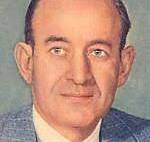
Governor Melvin E. Thompson
Thompson also persuaded the state to buy Jekyll Island for $670,000 after the island’s wealthy owners approached him about a purchase. Labeled “Thompson’s Folly” at the time, the purchase today is considered one of the savviest Georgia real estate deals ever, Meyers said.
“It turned out to be a pretty good move.”

Historical plaque noting Thompson’s effort
to get the State of Georgia to purchase Jekyll Island

M.E. Thompson Bridge, Jekyll Island Causeway,
SR 520 spans the Jekyll River between the Mainland and Jekyll Island
Meyers said Governor Arnall, for whom Thompson served as a top aide, helped to shape Thompson’s political views. “I think that is where he got a lot of his progressive” thinking, Meyers said, though other factors influenced him as well.
Thompson and wife Dora Anne Newton, both natives of Millen, spent the next chapter of their lives in Valdosta, where Thompson opened up M.E. Thompson Real Estate and raised his granddaughter, Carter Thompson.
Today, Valdosta honors him with M.E. Thompson Drive.
Carter Thompson is 62 and in ill-health.
She is battling a severe case of Long Covid-19 and complications of Epstein-Barr Virus. But memories of her grandfather are always with her, she said in a recent interview.
Carter Thompson said she thinks it was her grandfather’s humble sharecropper origins in Millen that shaped his progressive political views.
“He was an extraordinary individual who was able to overcome so many challenges,” his granddaughter said.
She is especially proud that her grandfather overcame the challenge of Herman Talmadge and the votes of the Telfair County dead he brought to their political contest.
“Herman and my grandfather had a complicated relationship,” Carter Thompson said. “I think Herman Talmadge was unkind to my grandfather in many ways. But he showed up at my grandfather’s funeral.”
Although she thinks her grandfather was appalled by the racist leanings of both Talmadges, Carter Thompson said she “never heard him say a harsh word about Herman Talmadge.”
Carter Thompson said she is especially proud of the forward-thinking M.E. Thompson showed in acquiring Jekyll Island and establishing it as a state park. “He wanted a family friendly affordable vacation spot. We vacationed there every year,” said Carter Thompson, who recalled she got lost on the island as an 8-year-old. Islanders, vacationers, police and Coast Guardsmen all joined a search for her.
Two women found her wandering near the bridge to the island and returned her to the family’s rental cottage. Before her return, “my grandfather was losing his mind,” Carter Thompson said.
Melvin Thompson and his wife are interred in Valdosta’s McClaine Riverview Memorial Gardens.
He has the Governor’s Seal on one side of the family mausoleum.
“He lived what he believed,” said Carter Thompson. “That is honorable in itself.”
She was 17 when her grandfather died. “He was so inspirational to me,” Carter Thompson said. “I draw my empathy from him and my lack of judgment. I certainly draw my Christian faith from him.”
He never talked unless he had something to say, Carter Thompson recalled.
But she listened well to the things that he did say, she said.
Others would do well to do the same with the thoughts and recollections of their grandparents, Carter Thompson said.
“Your grandparents bring so much to the table,” she said. “Sit down with them. Once they die, they take that with them.”

Governor Melvin E. Thompson signing a bill.
RELATED STORY: Read about the fight for life the late Gov. M.E. Thompson’s granddaughter Carter
https://www.laniercountynewsonline.com/2025/05/09/i-want-to-live-l…dignity-and-hope/
https://www.laniercountynewsonline.com/2025/05/01/late-gov-thompso…-with-long-covid/
A Go-Fund-Me campaign has been started to help Governor Thompson’s granddaughter, Long Covid patient Carter Thompson, with her Long Covid medical treatment. Readers who want to help can link here: https://gofund.me/aa28057d