New arena will highlight Macon’s music legacy, Macon-Bibb County says of $350 million project *
By T.S. Carter / * Inglés y español |
SOUTH GEORGIA – Macon occupied a prominent spot on the nation’s music map in the 1960s and ‘70s as the home of such rock n’ roll greats as Little Richard, legendary soul music artist Otis Redding and Southern Rock’s premier band The Allman Brothers Band.
This month, Macon will break ground on a 230,000+ square-foot p music palace to match the city’s music legacy. Designated as the Macon Arena, the $350 million concert hall will seat more than 10,000 people, with a total event capacity of approaching 12,000. 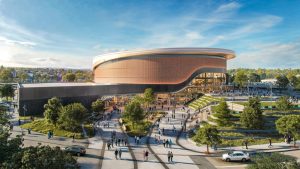
It will go up next to the 60-year-old Macon Coliseum, allowing the current building to remain in operation during construction.
The design incorporates Macon’s musical heritage and the Ocmulgee Mounds National Historical Park. The roof resembles a guitar pick and vinyl record, while exterior features evoke the Ocmulgee River.
Rendering: Designers are promising Macon’s planned
230,000 square-foot-plus arena “won’t have a bad seat in the house.”
“I certainly believe Macon has had an outsized impact on music in America and internationally, so reflecting that impact through the new arena designs seems entirely fitting,” said Larry D. Brumley, senior counsel to the president of Mercer University, in an email.
Macon-based Mercer University has had a large role in recent years in restoring a music recording legacy that led music professionals to dub the city as part of the “3 Ms” – Memphis, Muscle Shoals and Macon.
Specifically, the university was key in restoring the legendary recording home of the Allman Brothers Band, Capricorn Sound Studios, and reopening it as Mercer Music at Capricorn. Located at 530 Martin Luther King Jr. Blvd, the site was brought back from near-total disrepair through a major fundraising and renovation effort led by Mercer.
The facility officially celebrated its grand reopening on December 3, 2019, precisely marking the 50th anniversary of the original studio’s launch.
The Museum at Capricorn has a dedicated 1,200-square-foot exhibit space filled with historical artifacts, music murals, and digital interactive kiosks that detail Capricorn’s massive impact on Southern Rock and music history. 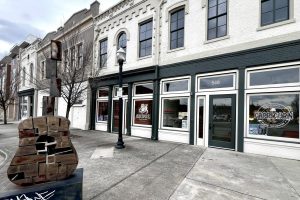
More than just a stagnant museum, the historic “Studio A” — where the Allman Brothers tracked their music—was meticulously restored to retain its original acoustics and vibe. It is paired with a brand-new, modernized “Studio B” for commercial music production.
Further, the complex features dedicated space to help train, foster, and inspire a new generation of up-and-coming musicians.
Mercer University’s Brumley said he thinks the new arena will be “an excellent addition to the other event venues in Macon and be complementary to places like Capricorn and Grant’s Lounge.
Capricorn Recording Studio is enjoying new life
after a restoration spearheaded by Mercer University.
Grant’s Lounge occupies a unique place in Macon’s music history. Opened in 1971 by Ed Grant Sr., it is widely regarded as the “Original Home of Southern Rock.” 
The small downtown club became an early proving ground for bands associated with nearby Capricorn Records, giving future stars such as the Allman Brothers Band, Lynyrd Skynyrd, The Marshall Tucker Band, Wet Willie and Tom Petty an intimate stage on which to perform before achieving national fame.
Opened in 1971, Grant’s Lounge is regarded as the “Original Home of Southern Rock.
Just as important, Grant’s Lounge was one of Macon’s first intentionally integrated nightclubs during the era of segregation, welcoming musicians and patrons of all races and musical styles. That inclusive atmosphere helped foster the creative collaboration that became a hallmark of Macon’s music scene and the development of Southern rock. More than 50 years later, the venue remains a live music club and one of the city’s most significant cultural landmarks.
There’s room for all of these venues to meet particular needs. It will be great for Macon.”
Beyond the legend of Southern Rock, Little Richard and Otis Redding cemented Macon’s reputation as one of America’s great music centers. They are regarded as two of the most influential artists to emerge from Macon.
Little Richard, who was born in Macon, developed his flamboyant stage presence, electrifying piano style and powerful vocals in the city’s churches, clubs and talent shows before launching the rock-and-roll career that influenced generations of performers. His groundbreaking recordings in the 1950s helped define the sound of early rock music.
Otis Redding moved to Macon as a child and got his start performing with local bands before recording for Capricorn Records’ predecessor, Redwal Music, and later Stax Records. He went on to become one of soul music’s greatest voices with classics such as “(Sittin’ On) The Dock of the Bay.”
Music entertainment is but one part of the offerings planned for the new arena, said Macon-Bibb County officials in the late June announcement of the arena.
Think packed trade shows, state athletic championships, basketball, wrestling, monster trucks/motor cross, graduation ceremonies, giant garage sales and even mega bashes for dancing the night away, county officials said.
“From visitors to athletic to entertainer, to staff, we’ve thought about them in this design, said Mayor Lester Miller, in the county’s press announcement.
“This will be a great experience for anyone walking through the doors,” he added.
Macon-Bibb County’s announcement promised “there won’t be a bad seat in the house.”
The county said that the design factored in
the ability to see well from every seat.
“A study was conducted to help ensure maximum visibility from every seat for any type of event being held, including premium clubs, suites and terraces, the announcement said.
A spectator bridge, the county said, will offer a one-of-a-kind vantage point for viewing inside the arena and of the city itself.
The arena will be funded by revenue bonds backed by money from tourist development taxes. The county has described the bonds as being supported by hotel occupancy taxes and other revenue generated by the arena and related tourism projects.
As for the tax itself, there are two different taxes:
*Existing hotel-motel tax – Macon-Bibb already levies a percentage-based hotel-motel tax that supports tourism.
*New hotel occupancy tax – The county approved an additional flat $3 per night charge on hotel rooms and short-term rentals beginning this year. Officials estimate it will generate about $2.5 million a year for tourism and capital projects, including helping support the new arena and other visitor-related projects.
However, the new tax is not a percentage “on each dollar” charged to visitors. It is a flat $3 per room per night, regardless of the room rate. For instance, a guest paying $100 for a room pays the same $3 occupancy tax as one paying $250, in addition to the existing hotel taxes.
A grand opening is slated for the summer of 2028.
Outdoor plazas and gathering spots will provide additional space for festivals, performances, watch parties, and civic celebrations, according to the county announcement.
An approximately 30,000-square-foot flex hall will be attached to provide ancillary program space, including capacity for an additional ice sheet, tradeshows, conferences, and various high school sporting events.
There will be two parking decks built with the arena: a 300-space structured VIP parking garage and a separate 500-space facility. The project will also include site improvements such as parking lot and drive lane reconfiguration, paving, and hardscape enhancements designed to complement and support the arena development, according to Macon-Bibb County.
The new arena will be situated on the current Macon Coliseum site, primarily on the parking lot near Second Street. Construction will occur on the existing surface parking areas, and the project will be phased to maintain ongoing operations of the existing arena throughout the duration of construction.
________________________
For our Spanish speakers / Para nuestros hablantes de español
________________________
El nuevo estadio resaltará el legado musical de Macon, afirma el condado de Macon-Bibb sobre un proyecto de 350 millones de dólares *
Por T.S. Carter / * Español por IA * |
SUR DE GEORGIA — Durante las décadas de 1960 y 1970, Macon ocupó un lugar destacado en el mapa musical de Estados Unidos como hogar de grandes figuras del rock and roll como Little Richard, la legendaria estrella del soul Otis Redding y la principal banda del Southern Rock, The Allman Brothers Band.
Este mes, Macon dará inicio a la construcción de un recinto musical de más de 230,000 pies cuadrados que estará a la altura de ese legado. Denominado Macon Arena, el proyecto de 350 millones de dólares contará con capacidad para más de 10,000 espectadores sentados y una capacidad total cercana a las 12,000 personas para distintos eventos.
El nuevo recinto se construirá junto al Coliseo de Macon, de aproximadamente 60 años de antigüedad, permitiendo que el edificio actual continúe operando mientras se desarrolla la construcción.
El diseño incorpora la herencia musical de Macon y la influencia del Parque Histórico Nacional Ocmulgee Mounds. El techo tendrá la forma de una púa de guitarra y un disco de vinilo, mientras que los elementos exteriores evocarán el río Ocmulgee.
«Sin duda creo que Macon ha tenido un impacto desproporcionadamente grande en la música de Estados Unidos y del mundo, por lo que reflejar esa influencia en el diseño de la nueva arena resulta completamente apropiado», expresó Larry D. Brumley, asesor jurídico principal del presidente de la Universidad Mercer, en un correo electrónico.
Mercer University y la preservación del legado musical
La Universidad Mercer, con sede en Macon, ha desempeñado un papel fundamental en los últimos años para restaurar el legado discográfico que llevó a profesionales de la industria a considerar a la ciudad parte de las famosas “Tres M” de la música estadounidense: Memphis, Muscle Shoals y Macon.
En particular, la universidad lideró la restauración de los históricos Capricorn Sound Studios, el legendario estudio donde grabaron los Allman Brothers Band, reabriéndolo como Mercer Music at Capricorn. Ubicado en el 530 Martin Luther King Jr. Blvd., el complejo fue rescatado del deterioro casi total mediante una importante campaña de recaudación de fondos y una extensa renovación encabezada por Mercer.
Las instalaciones celebraron oficialmente su reapertura el 3 de diciembre de 2019, exactamente 50 años después de la inauguración del estudio original.
El Museo Capricorn cuenta con un espacio de exhibición de aproximadamente 1,200 pies cuadrados lleno de objetos históricos, murales musicales y exhibiciones digitales interactivas que explican la enorme influencia de Capricorn Records en el Southern Rock y en la historia de la música estadounidense.
Pero el complejo es mucho más que un museo. El histórico Studio A, donde los Allman Brothers grabaron gran parte de su música, fue restaurado cuidadosamente para conservar su acústica y ambiente originales. Junto a él funciona un moderno Studio B, diseñado para producciones musicales comerciales.
Además, el complejo ofrece espacios dedicados a formar, apoyar e inspirar a una nueva generación de músicos.
Brumley afirmó que considera que la nueva arena será «una excelente incorporación a los demás recintos para eventos de Macon y complementará lugares como Capricorn y Grant’s Lounge».
Grant’s Lounge: la cuna del Southern Rock
Grant’s Lounge ocupa un lugar único en la historia musical de Macon. Abierto en 1971 por Ed Grant Sr., es ampliamente reconocido como el “Hogar Original del Southern Rock”.
El pequeño club del centro de la ciudad sirvió como escenario para muchas de las bandas asociadas con Capricorn Records, brindando sus primeras oportunidades a artistas que luego alcanzarían fama nacional, entre ellos:
- The Allman Brothers Band
- Lynyrd Skynyrd
- The Marshall Tucker Band
- Wet Willie
- Tom Petty
Igualmente importante fue su papel como uno de los primeros clubes nocturnos integrados racialmente en Macon durante la época de la segregación, dando la bienvenida a músicos y público de todas las razas y estilos musicales.
Ese ambiente inclusivo ayudó a fomentar la colaboración artística que terminaría definiendo la escena musical de Macon y el desarrollo del Southern Rock. Más de medio siglo después, Grant’s Lounge continúa funcionando como sala de conciertos y sigue siendo uno de los principales símbolos culturales de la ciudad.
«Hay espacio para que todos estos lugares satisfagan diferentes necesidades. Será algo muy positivo para Macon», añadió Brumley.
Little Richard y Otis Redding
Más allá del Southern Rock, Little Richard y Otis Redding consolidaron la reputación de Macon como uno de los grandes centros musicales de Estados Unidos.
Little Richard, nacido en Macon, desarrolló su extravagante presencia escénica, su electrizante estilo al piano y su poderosa voz en iglesias, clubes y concursos de talento locales antes de convertirse en uno de los pioneros del rock and roll. Sus grabaciones revolucionarias de la década de 1950 ayudaron a definir el sonido del rock temprano.
Otis Redding llegó a Macon siendo niño y comenzó actuando con bandas locales antes de grabar para Redwal Music, antecesora de Capricorn Records, y posteriormente para Stax Records. Se convirtió en una de las voces más importantes de la música soul gracias a clásicos como “(Sittin’ On) The Dock of the Bay.”
Mucho más que conciertos
Los funcionarios del condado de Macon-Bibb señalaron que los conciertos serán solo una parte de la programación del nuevo recinto.
El edificio también albergará:
- Ferias comerciales.
- Campeonatos deportivos estatales.
- Lucha libre.
- Eventos de camiones monstruo y motocross.
- Ceremonias de graduación.
- Grandes ventas comunitarias.
- Bailes y celebraciones masivas.
«Hemos pensado en todos durante el diseño: visitantes, atletas, artistas y empleados», afirmó el alcalde Lester Miller en el anuncio oficial del condado.
«Será una experiencia extraordinaria para cualquiera que atraviese estas puertas», agregó.
El condado asegura que «no habrá un mal asiento en toda la arena».
Para lograrlo, se realizó un estudio especializado que garantizara la máxima visibilidad desde cada asiento, incluidos los clubes premium, suites y terrazas.
Además, un puente elevado para espectadores ofrecerá una vista única tanto del interior del recinto como de la ciudad de Macon.
Cómo se financiará
La arena será financiada mediante bonos de ingresos respaldados por fondos provenientes del turismo.
El respaldo económico provendrá de:
- El impuesto hotelero ya existente, destinado al desarrollo turístico.
- Un nuevo cargo fijo de 3 dólares por habitación por noche, aprobado este año para hoteles y alojamientos de corto plazo.
Las autoridades estiman que este nuevo impuesto generará aproximadamente 2.5 millones de dólares anuales, destinados a proyectos turísticos y de infraestructura, incluida la nueva arena.
A diferencia de un impuesto porcentual, este cargo es fijo. Un huésped que pague 100 dólares por una habitación pagará los mismos 3 dólares adicionales que quien pague 250 dólares, además de los impuestos hoteleros ya existentes.
Apertura prevista para 2028
La inauguración oficial está prevista para el verano de 2028.
El proyecto incluirá plazas exteriores y áreas de reunión para festivales, conciertos, celebraciones cívicas y eventos comunitarios.
También contará con un salón flexible de aproximadamente 30,000 pies cuadrados, diseñado para exposiciones, conferencias, campeonatos deportivos escolares e incluso con capacidad para albergar una pista de hielo adicional.
Se construirán dos estacionamientos:
- Un estacionamiento VIP con aproximadamente 300 espacios.
- Un segundo estacionamiento con 500 espacios.
Asimismo, el proyecto contempla mejoras en accesos, reconfiguración de estacionamientos, nuevas vialidades internas, pavimentación y obras de urbanización para complementar el desarrollo.
La nueva arena se edificará en el actual sitio del Macon Coliseum, principalmente sobre el estacionamiento cercano a Second Street. La construcción se realizará por etapas para permitir que el coliseo continúe funcionando mientras avanzan las obras.